SHERNAAZ ENGINEER's blog on the Parsi community

Wednesday, September 26, 2012


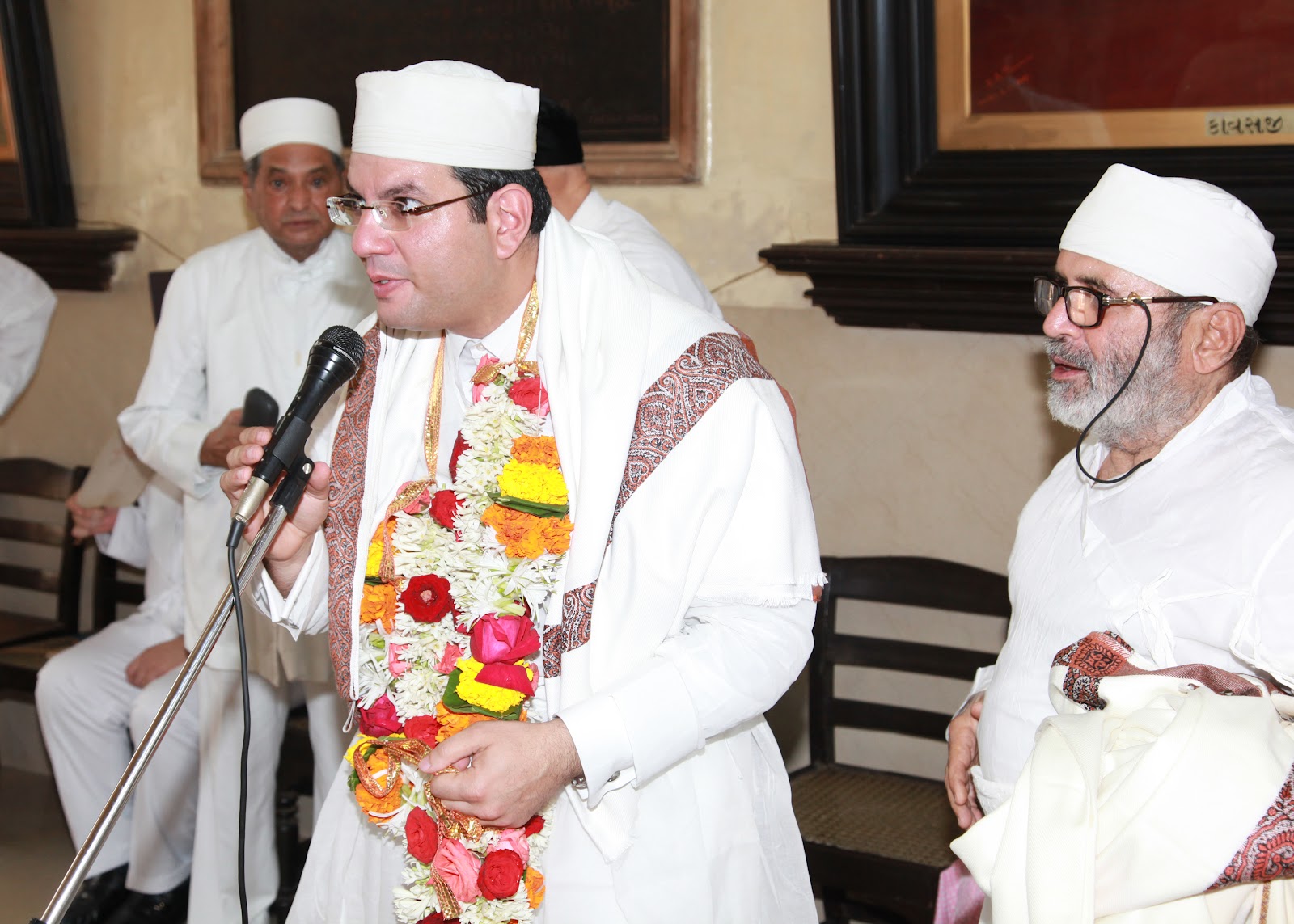
 At Mumbai's Anjuman Atash Behram, the new Nayab Dastur Dr. Jamasp was installed on Roj Ardibehesth Mah Ardibehesth, September 19, 2012, as trustee of the Atash Behram, Burjorji Antia looks on


Emergence of the new order
It is always exciting to witness the ascendance of the new order.
Few as we are, and fewer still as we appear to be getting, nothing gladdens the community more than the resurgence of the Parsi spirit with the arrival of fresh blood!
Kindly cast aside your cynicism, if you’re one of those jaded sorts who sighs and declares that GenNext is just not interested in religious adherence.
Week after week, we’re amazed at the response younger readers give us, particularly when it comes to articles pertaining to a further understanding of the faith. Believe it or not but young Parsis, for most of the part, are passionate about preserving both Parsipanu and the Zoroastrian religion.
Do read the story on the centre pages of aapru Jame this week, of how twenty-somethings across the world feel about being Parsi Zoroastrians and how infectious and admirable is their zeal!
And, yet, the road is not entirely easy for them, especially for those living in the West, where popular culture and peer pressure are often at odds with traditional religious practice.
That they still manage to hold on to our precious legacy and are proud of it, speaks volumes not just for the way in which they’ve been raised, but also for the power and glory of what has been given to us thousands of years ago by our Prophet.
It is a gift that cannot be taken for granted. And one that brings continuing joy for those who foster the faith!
Earlier this week, at Mumbai’s resplendent Anjuman Atash Behram, a beloved bastion of the devout, the 115th Salgreh festivities on September 19 turned into a double celebration with the induction of Nayab Dastur Dr. Jamasp, scion of the illustrious Jamasp Asa clan.
Succession planning is one of the most challenging and rewarding exercises that few enterprises or institutions can afford to ignore. Sadly, at the Wadiaji Atash Behram, a worthy successor wasn’t initiated upon the retirement of Vada Dasturji Dr. Firoze Kotwal
several years ago, although, reportedly, there’s no hereditary ‘gaadi’ of Dasturi there.
However, there is no reason why another scholar priest could not have been – or still cannot be – installed. If our biggest Atash Behrams don’t nurture the emergence of religious scholars of the stature of some of our current senior Vada Dasturjis, where is the young generation going to get guidance from?
The community and its Trusts must facilitate the emergence of a new cadre of Vada
Dasturji who will bring us credit with their scholarship, their understanding of contemporary issues and, above all, their unflinching resolve to conduct themselves with grace, without ever compromising on the core principles of the religion that have stood the test of time and made us who we are.
This reminds us of Tennyson’s sagacious assertion that “the old order changeth yielding place to new, and God fulfills Himself in many ways…”

Monday, April 25, 2011

Will Iranshah's Grace Be Wasted Upon Us?

Iranshah, refurbished recently...

Iranshah, the way it was...

April 24.
A supremely sanctified day has dawned upon us! Today, the ninth day of the ninth month of the Parsi calendar, Roj Adar Mah Adar, is the perfect occasion to humbly venerate the beneficent glory of our Atash Padshah Sahebs. Generations of devout Parsis have invested their faith in the Holy Fires.
Today, we also celebrate the 1290th Salgreh of our Iranshah Saheb. Can one even fathom the sheer span of this sweeping time frame, extending over close to 13 centuries? Rare is the Parsi who in all these 1290 years would not have bowed his or her head before this King of Holy Fires.
While Iranshah has undoubtedly bestowed untold blessings upon us, perhaps it’s pertinent to reflect upon our present-day worthiness for His grace. Are we acting in a manner that does justice to the benedictions being showered upon us by our ancient and efficacious fires?
Well over 1000 years ago, our journey of faith commenced with one objective: to preserve the religion and the race. All those who left Iran for unknown shores, our noble and fore-sighted ancestors, put the preservation of our Parsi legacy above personal comfort and convenience. They willingly staked everything – their homes, their fortunes, their friends and all things familiar – and set sail to keep the faith.
Once here, with much dedication and discipline, they stuck to time-tested principles that guaranteed our survival. Pioneering and forward thinking in their approach, they also reinforced the foundation of the faith. Realising that we would always be a small and stand-alone sect within the Indian mainstream, they endowed us with enough Trusts to take care of all of our worldly needs, so we’d never be wanting for anything: housing, medicine, education and so much more.
They integrated seamlessly into the cosmopolitan framework of society, contributing in many ways that enriched public life, earning the sort of glittering goodwill that still holds us in good stead. Yet, they took care to assiduously safeguard the Parsi identity. They saw no shame in preserving and perpetuating our Parsipanu, as it’s something that is uniquely our own. You can discard your destiny only at your own peril.
So, is it that our generation has suddenly stumbled upon insurmountable challenges? Is it that we have miraculously come upon the wisdom to debunk the spiritual sagacity of generations of seers and scholars? Obsessed as we are with the here and now, are we forgetting to look at the larger picture? Should we focus on long term survival or short term expediency?
An occasion like the 1290th Salgreh of Iranshah raises these questions. What if our forefathers hadn’t been steadfast and single-minded when it came to sticking to the straight path? What if they had veered away, for one reason or another – and there are so many reasons one can find when it comes to wanting to do one’s own thing!
Iranshah has bountifully blessed us over 1290 years. How can we ensure that 1290 years hence, Iranshah will still be able to bless our flock?
Many noble Fravashis, over 1000 years ago, sacrificed a lot to give us this day. Gentle reader, wont Iranshah’s grace be wasted if we don’t promise to do as much?
editorjamejamshed@gmail.com

Thursday, September 23, 2010

Something To Remember Us By

Whenever we hear of a tragic, untimely death, or even a much-awaited release at the end of one of those lingering-a-bit-too-long life spans, the pang we feel is only partly for the soul that has passed into the unknown, leaving bereft family and friends behind.
More significantly, it serves as an uncomfortable reminder of our own date with fate. No one is born to live forever. Yet in the bustle of our blinkered lives we tend to believe the bubble will never burst. Then, suddenly, it does – but it was always meant to, a little bit earlier or later.
We are immortal only to the extent of the values we immortalize. The young Naval Officer, Lt Cdr Firdaus Mogal, who bravely jumped to his death in Mumbai recently, in a bid to save a fellow sailor who had fallen off his submarine, will forever enshrine courage and commitment to duty that will inspire countless others.
Our lives are worth something only if they serve the larger plan of upholding the Divine Order that enables righteousness and the highest truth to triumph. This happens when we live a life of purpose. The late Lt Cdr Mogal not only lived on purpose, fulfilling his dream of serving the nation as a committed Naval officer, but also died upholding his purpose, courageously attending to the call of duty.
Blessed was he and his death is not in vain, because his life’s mission of service before self is now a beacon of light for all those who’re letting time pass them by without pursuing their purpose. Whiling away the days allotted to us and lethargically ignoring the impetus to live our best lives is an affliction that brings no glory.
Sometimes, it’s difficult to determine what our purpose is. At the Ava Roj Humbandagi, held at the Bhikha Behram kua, as a tight circle including a busload of young girls from the Ava Bai Petit School clustered around the sacred well, Ervad Dr. Ramiyar Karanjia spoke eloquently about finding our purpose through prayer.
Divine Order, he explained, guides every aspect of our lives and of all creation. It’s the inherent energy and intelligence that can cause a towering tree to grow out of a tiny seed, the sun to rise and set infallibly every day, the seasons to come and go, the tide to ebb and flow.
Divine Order can direct our journey through this lifetime, if we invoke Ahura Mazda’s grace. Our prayers become a powerful tool in helping us attune our life’s pursuits with our higher purpose.
I believe other benchmarks are the noble lives of those who passed on, whose good works become the guiding lights of our destiny. Every soul leaves behind an incomplete story. We exist to further the unfinished aspirations of our ancestors.
May the Fravashis of our dear departed and the Divine Immortals bless our community and give us the wisdom to carry forward all the values our illustrious Parsi predecessors lived and died for – so this ongoing, inspiring legacy of luminosity remains something to remember us by.
editorjamejamshed@gmail.com


Tuesday, August 10, 2010

Why the New Tata CEO Matters So Much to Parsis

Ratan N. Tata, Chairman, Indian Hotels Ltd. at the Company's 109th AGM on Aug 5 in Mumbai
Understandably, everybody is all agog. The countdown to Ratan Tata’s retirement has officially begun with the appointment of a committee to select his successor. Like all good things, his winning inning at the helm of the Tata Group must inevitably come to an end. While admiring his grace in letting go by meticulously adhering to his own guideline of stepping off at 75, there’s the inevitable twinge that comes with the end of an era.
Under his leadership, the Tata Group has prospered. He has, with understated sagacity and admirable work ethic, exalted not just Brand Tata but Brand India in business circles around the world.
But, above all, and perhaps without his realizing it, he has reinforced Brand Parsi better than anyone in recent times. Ratan Tata, for all his low profile modesty, is the best known Parsi on the planet.
For a community that is so small in numbers, such an illustrious Brand Ambassador is an irreplaceable asset. One is not being parochial by basking in the Parsiness of his personality! That sense of fair play, that adherence to ethics, that gumption in venturing into realms just a little out of reach (Jaguar, Corus), that determination to excel, that humility… all of this and more is just, well, deeply embedded in the DNA.
These are values that have been instilled in us by our forefathers and we gratefully acknowledge the debt and depth of this lineage by living up to it as best as we can. Many Parsis do this in their own simple sphere of activity; Ratan Tata has epitomized and exemplified it on a global panoramic platform to justifiable acclaim.
He is as aapro as they come – perhaps, a wee bit more than most other celebrated Sons of the Sudreh.
The heads of the House of Tatas have been admired and adored by the community down the ages. For JRD Tata, this realization dawned in the dusk of his years. He then confessed that he never quite understood why the Parsis had consistently showered so much love upon him when he had never done anything tangible for the community.
However, for most Parsis, our ethos and identity is in many ways synonymous with the House of Tatas. All the way from Jamsetji, who remains a hero even amongst GenNext, to the reigning Ratan, Parsis feel incredibly proprietary about the House of Tatas. Most of us have personal histories that are intertwined with the Tata empire – may the sun never set upon it.
And this goes way beyond the multi-billion valuation of the Group. It’s not about wealth but about a shared vision and values, generation after generation. While the new heir will (and must) be picked on merit, many in the community (and beyond) are rooting for both a Parsi and a Tata.
For well over a century, ‘Tata’ and ‘Parsi’ have been two sides of the same coin – it’s the currency millions across the world have faith in. We are willing to bank on it yet again!
editorjamejamshed@gmail.com

To subscribe to Jam-e-Jamshed, the leading Parsi publication, write to jame1832@gmail.com

Saturday, June 19, 2010


Banish those Botas!
What, for most Parsis, is the worst word in the English language? It begins with the letter ‘V’… ‘Vegetarian’!
No affront or insult could possibly be worse than the blood-curdling indignation, alarm and aversion that ‘V for Vegetarian’ induces. Parents almost always never teach it to their children, preferring A for Aleti-Paleti, B for Boomla, C for Chhamna… instead.
When it comes to tucking in, bawajis just cannot do without their botas – reformists and traditionalists alike. Food is the great leveler for every Parsi reveller!
Suggesting vegetarianism is akin to asking Warren Anderson to return to India and take some accountability for the Bhopal gas tragedy – it’s pointless and a perfect waste of time. So why are we bothering to bring it up?
Well, it’s Bahman mahino – that time of year when we’re supposed to spare poor little animals the tragic plight of being butchered, basted, broiled, baked and barbecued for our meals – at the very least on some days of the month.
Ouch!
Should you decide to continue reading ahead, a few unresolved questions: Are animals meant to be eaten? We have heard of the food chain and how vegetables are intended to be eaten by animals and, conversely, animals are supposed to be eaten by human beings. This is theoretical the ‘cycle of life’, but is it really so?
Do animals hurt as much as we do? In their final moments, as the fish is hooked and writhing for that last breath before being forever stilled for saas-ni-machhi, or the goat is hacked and bled to death for Sunday’s dhansak-kawab, or the chicken is slaughtered and de-feathered for those deep fried faarchas, in their final moments, do animals feel the pang of separation from the little families they have nurtured… or been nurtured by? Do they wish they could spend a few more moments on God’s great earth, unfettered under a blue sky (or a starlit one), instead of having their lives snuffed out for voracious human palates?
Parsis have been indomitably feasting on animals for the longest time. We even seem to delight in all their bits and parts with grisly zeal – puchri, doki, pag, bheja, kalejee, paya, khariya, jeebh… go on, feed your greed!
Our lagans and navjotes are occasions for mass animal slaughter. Of course, we don’t feel guilty since we don’t actually kill the animals ourselves – we just pay the butchers to do so and enjoy our meal. Which is how it should be, isnt it? Our social conditioning ensures we don’t get unduly bothered.
Vegetarians are often asked, aren’t you killing plants when you eat them? Perhaps. Or perhaps not – most fruits and vegetables are the offerings of plants and trees. You seldom eat the whole plant or tree itself.
Animals on the other hand are, well, animate. They run, they yelp, they see, they react, they bleed. Ironically, as a community, we love animals and care for them with the sort of deep devotion you don’t often find.
Bahman mahino, then, ordains a little more respect and a little more restraint when it comes to making a meal out of innocent animals. They have a right to life too.
editorjamejamshed@gmail.com

Monday, June 14, 2010

Dr. Cyrus Poonawalla Bereaved

Late Villoo Poonawalla with Dr. Cyrus Poonawalla at the Mahalakshmi Race Course in Mumbai earlier this year
Villoo Poonawalla, wife of Dr. Cyrus Poonawalla and mother of Adar, passed away on June 8, leaving an irreplaceable void in the Poonawalla family. She is also mourned by daughter-in-law Natasha and grandson Cyrus, as well as other family members and friends.
Villoo Poonawalla was a low profile and graceful lady, preferring to live out of the spotlight. However, she was the backbone of her family and lived up to the proverb: Behind every successful man, there is a woman.
Gracious and graceful, she was often spotted at the Race Course, sharing her husband’s passion for racing. At the Poonawalla Breeders’ Multimillion, held this year at the Mahalakshmi Race Course on February 28, she was, as every year, the hostess with the mostess!
However, her life was not merely all glitz and glamour. Deeply religious, she was a proud and practicing Parsi till the very end. In a recent (albeit rare) interview, Dr. Poonawalla had confessed, “My wife, Villoo, comes from a priestly Athornan family (nee Panthaky) and is a devout Parsi – very religious. She prays for several hours every day.”
Perhaps, Dr. Poonawalla’s stupendous success was wrought, in some measure, by the power of her prayers.
At the all-Parsi youth meet held in Pune last month, it is said that it was at her insistence that her son, Adar, came forward with a generous sponsorship to enable the event organisors meet the expenses.
One wishes eternal behesht for her soul. May her love for our community and our religion be a legacy that forever guides the Poonawalla family, so that the virtues of philanthropy, compassion and community service continue to perpetuate her memory. R.I.P.
* This article appeared in the Jam-e-Jamshed dated Sunday, June 13, 2010. To subscribe to the Jame email: jame1832@gmail.com

Friday, June 11, 2010

Apologies...

This blog has not been updated in a long time. Apologies to all those who have taken, and are taking, the trouble to visit it and have found it static!

Truth is, life has been anything but static.

Ever since I assumed Editorship of Jam-e-Jamshed on 14.1.2010, there has barely been time to blink. The paper, at 178-years, is Asia's second oldest and the responsibility is both an honour as well as onerous. The Jame is part and parcel of many, many Parsi homes in India and abroad (if you don't get it, do consider subscribing). We are committed to keeping this much-loved community institution robust and raring-to-go!

Will, in the coming weeks, continue to post more columns...

Till then, thanks for taking the trouble to drop by!

Sunday, October 25, 2009

Why Dokhmenishini is Ordained in Zoroastrianism


ERVAD DR. RAMIYAR PARVEZ KARANJIA, is the Principal of the Dadar Athornan Institute and the Sir J. J. Z. and Mullan Feroze Madressas (Institute for Indo-Iranian Studies). He has obtained his Masters and Doctorate in Avesta-Pahlavi from Bombay University. He conducts courses, classes, gives talks, organises seminars and presents papers on the Zoroastrian religion, spirituality and Iranian history all over the world, for children, youth and adults. He has authored various books and papers and has worked as a research scholar with several prestigious Universities and Institutes in Germany and Moscow.
Here, he explains why Parsi/Irani Zoroastrians need to follow the ordained practice of Dokhmenashini, and abstain from alternate methods of disposal after death.

Q. What is the significance of Dokhmenishini?
A. Dokhmenishini, the Zoroastrian mode of the disposal of the dead, is designed to ensure theological correctness, ecological safeguards and spiritual fortification. It also harnesses the powers of disinfection of the sun and the wind. Exposure of the body is very essential from a spiritual point of view, as it’s through the rays of the sun that the spirit is drawn upwards.

Q. Perhaps our ancestors weren’t aware of cremation, hence the present reservation against it?
A.
Our ancestors were well aware of the method of disposal of the dead by burning. They were even aware that it is the worst form of defiling fire and, that is why, among the 16 fires comprising an Atash Behram, the fire called ‘murde-suz’ (or fire from a burning corpse) is used after purifying and consecrating it the most number of times.

Q. Is even electric cremation considered incorrect?
A.
Cremation, or burning the body, either through the traditional mode or electric mode, is considered incorrect in the Zoroastrian tradition for several reasons. Fire is given great reverence in the Zoroastrian religion, and so is air. Cremation (even electric cremation) is responsible for polluting fire as well as air. The Avesta talks about at least six different fires. Latent energy in all matter is considered as fire – hence, electricity is also a form of fire.

People argue that electric cremation isn’t ‘fire’. Then by what process is the body reduced to ashes within a few minutes? Moreover, after the body reaches a temperature of 600 degrees centigrade, it actually bursts out in flames. Oxford Dictionary (p.193) defines meaning of Cremation: Burning as method of disposing of corpses. Incinerate (p.408): Consume by fire.

Q. Are there specific religious injunctions against cremation?
A.
The following are the references from Zoroastrian scriptures against burning of Nasu – that is human dead matter – in any form. Nasu not only creates physical pollution and putridity, it is also responsible for creating spiritual imbalance – referred to in our religion as Druji-i-Nasu – for the following reasons:

1. A corpse is the greatest source of Nasa (putrefaction) in the world. Burning a corpse desecrates fire, which we worship as the living representative of Ahura Mazda. Putting any putrefying matter on fire is a sin.

2. One of the chapters of the Husparam Nask deals with the sin of throwing bodily refuse in the fire.

3. Burning Nasu is considered to be a ‘margarjan’ sin, i.e., a sin worthy of being punished by death. Burning of the hair on the body is also considered a ‘margarjan’ sin, as hair and nail are also nasa.

4. A man burning matter is considered worthy of contempt, as the religion considers such an act partly responsible for natural calamities like climate fluctuations. It is further stated that imbalances in ecology like extremely severe winters are due to burning Nasu.

5. Wood contaminated by Nasu is also forbidden to be taken to fire. Fire is to be kept at least three paces away from Nasu.

6. It is meritorious for a person to prevent a corpse from burning. (Vd.VIII.81)

7. It is a sin to either take dead matter/Nasu near fire or water or vice-versa (Patet Pashemani V).

8. The soul of the person who takes Nasu to the fire is never liberated from hell.

9. Fires at three different places – where the person dies, where the body was kept after Sachkar, and at Sagdi – protects the soul for the first three days from the demon Vizaresh.

10. The tenth chapter of the Sudkar Nask deals with the complaint of fire to Ahura Mazda. When fire is used to burn even a blister or corn, or hair and filth falls on fire, or a child burns itself by fire due to the carelessness of the parents, or when fire is blown upon, it becomes unhappy.

Q. Some Parsis feel cremation is more dignified. Would you agree?
A.
Each method of disposal is as ‘dignified’ as you deem it to be. It’s a fact that while being burnt the skull bursts, and faeces comes out of the mouth and rectum. Scientifically, too, burning a corpse is a health hazard as it gives rise to air pollution through the release of carbon and nitrogenous gases and other bone ash and protein residues emitted by the burning body. Those who live near an electric crematorium face this problem.

Q. If cremation is unacceptable in Mumbai, why is it acceptable in other cities/countries?
A.
Cremation is unacceptable, according to our Zoroastrian religion, anywhere in the world. Wherever there are no Dakhmas, one has to avail other modes of disposal to dispose the corpse. However, where Dakhmas are available it’s a part of our religious requirement to consign the body therein. It’s pertinent to note here that when our ancestors came to India, and later in India when they settled at different places, the first thing they would do is construct a Dakhma and consecrate it, because they considered it paramount to the well-being of their soul and spiritual evolution after death.

Q. Why deny Parsis their prayers for four days (in case they opt cremation), and then start prayers thereafter?
A.
Parsis started having second thoughts and doubts about their Dokhmenishini system, especially after coming in touch with Western culture, which looked down upon it as “barbaric” – in Iran due to the close proximity of the Shah with the Europeans and in India with that of the British.

In India, the elders of the religion realised this trend long ago and, therefore, to set discipline among their flock decreed that wherever there were Dakhmas Zoroastrians needed to confine their dead bodies to them. If they do not do so, then to show them that they are wrong and that their after-death prayers will not be effective enough, it was decided that priests be informed not to perform the four-day death rituals for such people who select a mode of disposal, which is not acceptable to the religion – even though the correct mode is available to them.

Q. But yet, when Parsis die in places where there are no Dakhmas, the four-day prayers are performed for all alternate disposals?
A.
If a body is disposed in other ways, where Dokhmenishini is not available, they are not willingly choosing the mode. It is out of compulsion of circumstance, which the religious elders understood. Hence, no such restrictions were kept for places where Dakhmas are not available.

Q. Surely people have freedom of choice and can choose their mode of disposal?
A.
Freedom of choice is a much-maligned term. Freedom, too, has its limits. When we are part of a larger body or society, we have to adhere to its discipline and laws. In civil society, we cannot roam without our clothes on. In the same way, we cannot go to a school without a uniform, at least in India. Similarly, a house has its own rules and so does a country. A religion, likewise, has certain requirements of its adherents – one of which is the mode of disposal of the dead.

Q. Is it right to penalise priests who offer to perform last rights for cremations?
A.
Consigning bodies to cremation is considered wrong, as explained earlier. Priests who knowingly assist community members in pursuing the wrong path are, hence, wrong too. They’re accomplices to a wrong-doing, and are going against the wishes of the religious elders who have very valid reasons for guiding the community along the right path – a path that will ensure our progress and preservation. The larger good must always prevail over personal will and fancy.

Q. Is the present system of Dokhmenishini functioning optimally in Mumbai?
A.
The physical (I will not talk of the Astral and spiritual aspects here) system of Dokhmenishini works on 3 main principles, according to the Vendidad:
a. It should be on an elevated place
b. It should be exposed to the rays of the sun (both the heat and light giving ones, as well as infra)
c. It should be exposed to carrion (preferable vultures; kites, eagles and crows also work, albeit slowly and less effectively)
Of the 3 above, a. and b. are there and c. has slowed down – b. is not optimal during monsoons. In spite of the above short comings, Dokhmenashini works. It has not failed. A bit slowed down, yes, but highly functional anyway. Even in its less-than-perfectly-optimal state, it’s still the best system for us.

Q. Is it fair that inter-married family members/friends cannot be part of traditional Zoroastrian last rites?
A.
On account of certain spiritual requirements no Zoroastrian prayers and rituals can be performed in the presence of non-Zoroastrians, or even Zoroastrians who are in a certain ritually impure state. The same rule applies for entry to Fire-Temples as also for rituals and ceremonies pertaining to the deceased. It’s not on account of discrimination or high-handedness that non-Zoroastrian family members and friends are requested not to be part of these rituals. These rules are for the betterment of the soul of the deceased, as well as for the well-being of the living. One should not have hard-feelings on account of these rules.

Q. Finally, how important is Dokhmenishini for the Zoroastrian soul and what happens to those souls who don’t opt for it?
A.
In spiritual matters, one has to go by the wisdom of the scriptures (given by the Prophet and other spiritually advanced souls) as well as the traditions laid down by our worthy and noble ancestors. Both the above sources regard Dokhmenishini as essential for the speedy release of the soul and its Astral components from the material world and the subsequent judgment and progress of the soul. For the unfortunate souls who do not get the benefit of Dokhmenishini, this process is evidently much slower and more painful.

Bibliography of Sources for this interview:
1. Bharucha, S.D., Rististan, Bombay, 1917.
2. Boyce Mary, ZOROASTRIANS Their religious beliefs and practices, London, 1979.
3. Darmesteter James, The Sacred Books of the East, The Zend Avesta Part I, Oxford, 1895.
4. Dhabhar Bamanji N., The Persian Rivayats of Hormazyar Frmarz, Bombay, 1932
5. Jamasp Asa Dastur Kaikhushru J., Arda Viraf Nameh, Bombay 1902.
6. Kanga Kavasji E., Vendidad, Bombay 1874.
7. West E.W., The Sacred Books of the East, Pahlavi Texts Part XXIV, Oxford, 1885.
8. West E.W., The Sacred Books of the East, Pahlavi Texts Part XXXVII, Oxford, 1892


* This interview appeared in the October ’09 issue of The BPP Review of the Bombay Parsi Punchayet

Sunday, September 27, 2009

Dr. Keki Gharda: Man with a Mission


By Shernaaz Engineer

In recent months, the papers have been buzzing with the news that Gharda Chemicals, the second-largest agro-chemical company in India (Rs. 950-crore turnover), is likely to be sold. Dr. Keki Gharda, Chairman and MD, a veteran chemical scientist, and his wife, Abaan, have planned a public trust to use sale proceeds for philanthropy and to promote industrial research. Here, Dr. Keki Gharda affords a profoundly personal glimpse into his life, times, mission and vision… in his own words.

I saw what attachment to money did…
I was born on September 25, 1929, of Kadmi Zoroastrian parents. My parents (father Hormusji Dinshawji Gharda and mother Ratanbai Gharda nee Madon) were both from Athornan families. I never became a navar, as I thought it a waste of important years of my life. I’m somewhat of an agnostic, but an honest man. Of course, one does not preclude the other!
My father was an MA in English – in fact, he was one of the early few to do their MA from the Bombay University back in 1901. My mother studied until the fourth standard. There was a prejudice in those days that menstruating girls had to be taken out of school. But she nursed a passion for learning and I found as a child that she was very well read. However, she was self-trained and the English classics were her favourites. Her father was a medical doctor and a very interesting man. He, too, was very well read and I remember borrowing books from him. He had a wonderful memory, even in his 90s. He would engage me in arguments over Shakespeare’s plays, which I borrowed from him to read. If you mentioned a quote, he knew the Act and Scene it was from! He was also a humanist and a philanthropist. Not only would he not charge poor patients, but he’d give them money to buy better food. As I grew up, this stayed at the back of my mind.
From my father’s side, my paternal grandfather was a practicing senior priest in one of the Atash Behrams – I cannot recall which one. We stayed in a joint family. Both my grandfathers lived long lives (paternal beyond 85 and maternal beyond 95) so I have longevity in my genes! My father was one of four sons and several daughters, and he never practised as a priest but as an interpreter at the Bombay High Court. I was barely five when my paternal grandpa died and our joint family broke up. Two of my uncles were a bit crooked and persuaded my grandfather to give them his property. This soured my father a great deal and he continued fretting about it. We had an acrimonious household and I felt this was a stupid way of living. I was a conventional religious person until that point. I still wear my ‘sudreh’ and ‘kusti’, even though I’m agnostic. I saw that despite being religious, my father was attached to money and made himself unnecessarily unhappy.
We lived in a rented place in Bandra on Hill Road, and I would tell him that it was alright as we were comfortable in most ways. I schooled at St. Stanislaus, where they did not teach any vernacular language so I have poor familiarity with Gujarati. I used to go to the Petit Library to borrow books, and my mother and I would read them. My mother often told me to study and not read so many books. I told her: I come first in class, I am doing my job; now you do yours and leave me alone! I was extraordinarily talented – there’s no point beating about the bush. I went to the Elphinstone College, which drew bright students from all over, but I did well there too. My mother had, by then, started telling me often: It’s your duty to make as much money as you can honestly throughout your life, but you should die poor. She told me her father did the same thing – giving away a lot in charity.
I had two sisters and was slightly pampered as the youngest male child. Besides, we Paris are conceited because our skin colour is a little light! However, my parents only admitted me to primary school – thereafter I made it on my own merit. By the age of 15 I was functioning as the head of our household. My elder sisters were quarrelsome and had their own mind. I used to control them because my father could not!
Gharda Chemicals was thrust on me…
I believe you are what you are because of your genes (85 percent) and the remaining is shaped by your environment, which also you cannot always choose. I think we’re creatures of chance floating around the cosmos and have no reason to be conceited. I am gifted with good brains and believe I have unusual talents to be used for the benefit of others. Most people search for happiness through the accumulation of material wealth. I also accumulate wealth – but for others. That gives me happiness and continues to motivate me. I’m a Parsi Zoroastrian, and in the Parsi culture there is a large emphasis on work ethic. That is why Parsis have been largely successful.
When I look back on how I started Gharda Chemicals, I must concede it was virtually thrust upon me. I had finished my PhD in the US with three scholarships from three leading chemical companies – incidentally I am now competing with them and making them uncomfortable! I did well, studying and later teaching (Chemical Engineering for a while at the University of Oklahoma). I came back to India after six years to see my parents and found that my father was hospitalised. During my visit, he died. My mother was left all alone, and she didn’t know much about money. She told me to stay back. I had a permanent job in the US and they said they could hold it for a year. I told them it was unlikely I would return. I worked as a Consultant for some time. I felt I was being underpaid. So I saved some money, and my sisters and mother all put together some and I started Gharda Chemicals with Rs. 2 lakh in 1964. We began operating in 1966. Gharda’s first product was a dye called German Blue. This used to be made by a big multinational and I started out copying them. But in two to three years I improved it and made it a superior product at a lower price. From the start of my career I was making multinationals ‘run’! My business was run on both idealism and pragmatism. My idealism was that if I could make something cheaper, it was wrong to sell it at a much higher price. My pragmatism was that this drove away competition!
When you start a business, for the first five years there is generally no profit and you don’t pay the staff any bonus. But we started doing so almost immediately and over the years have had very little labour problems. We’ve had one or two strikes and I’d tell the workers I don’t care for money, but you will lose your livelihood. They would come back to work, saying their wives sent them back!
We have grown with internal resources. We stared with Rs. 2 lakh and today have over Rs. 500 crore (capital plus reserves). And this is after paying all our taxed honestly. Our current valuation is between Rs. 1,000-1,200 crore. We sell our goods all over the world, with the exception of Japan. We started with just nine people. I used to work 16-hours-a-day, coming home after midnight. The neighbours asked my wife, Abaan, if I had a mistress. She would say yes – Chemical Technology! I remember telling my wife one day – I have two loves, my work and you; but work will always come first.
Today, we have 1800 people across four factories. Our factories are world-class and we have met all the ISO standards for chemical manufacture and continue to have a strong emphasis on R&D.

No pressure to live fancily…
My wife, Abaan is a graduate from St. Xavier’s College and she did her PhD from the University of Mumbai. We live a simple life, and since both of us are PhD’s I used to joke that she had the most educated driver and I had the most educated cook anybody could have! For years we kept no servants – a year ago we started employing a part-timer. Abaan still cooks. I used to wash my own clothes, not out of spirit of masochism but because I am not fortune’s hostage. My wife, I must say, has never asked me for anything – not even jewellery. We run the house on about Rs.10,000 per month, and we have never been under any pressure to live a fancy lifestyle. If she sometimes falls short of cash, she adds a little out of her own savings!
I am now in the process of creating the Abaan and Keki Gharda Foundation, on the lines of the Belinda and Bill Gates Foundation (with a contribution of Rs. 600-700 crore). The new Foundation will comprise: 1.The Gharda Foundation, which is a social work organisation running two small hospitals in Dombivili and Lote (on the Mumbai-Goa road); 2. A research foundation, which will undertake research (my passion) and also generate funds through research for the Foundation.
Over the years, we have instituted various welfare projects. We have a mobile clinic that goes into the villages near our factories to offer health care advice. We have mobile libraries attached to each factory and they go from village to village. We have two hospitals, which I mentioned earlier, run to high standards. We have also started an Engineering College in the Konkan region, near Chiplun, called the Gharda Institute of Technology (GIT), and it offers Chemical/Electrical/Mechanical Engineering and Computer Science. I have already spent Rs. 40 crore on it and will spend another 10. We have 60 students, all selected through the Common Entrance Test. If any Parsi students show an inclination for engineering and get through the Common Entrance Test, then I could help them with admissions through my management quota. But for me to reserve seats for Parsis may not be possible. Within the next five years I see the institute getting the top accreditations in the country. We are also exploring the option of students getting an MBA in the fifth year of their engineering degree, in association with the Wellingkar Institute.
As Parsis, we have a legacy of hard work and social service. There have been so many institutes built with Parsi money in our country. (In my case, Parsi money and parsimony could be an apt pun!). As Parsis we are barely 50,000 in India’s one billion population. Yet in all the professions, in whatever field, there is always at least one Parsi right at the top! In my own field, several accolades have come my way, but the one I cherish is the American Institute of Chemists Award – this is generally an award given to chemists (not chemical engineers) and three out of ten winners of this award go on to win the Nobel Prize. I was the first Asian to get it. Now, I am in the process of selling my company and focusing on my two passions: social work and research. I have some innovative ideas for research and, who knows, I may end up with the Nobel Prize!
This artilce appeared in Jame Jamshed, dated Sept 27, '09

Tuesday, June 16, 2009

Young Zoroastrians: This One’s for You!

My nephew, Jehan Engineer, a budding young Zoroastrian -- may his tribe increase!

Life is no brief candle to me. It is a sort of splendid torch which I have got hold of for the moment, and I want to make it burn as brightly as I can before handing it on to future generations” – GBS

Young Zoroastrian Friends…
Mired as we are in myriad controversies, the community’s GenNext needs to shake off all sloth and stand up to the test, because the future certainly belongs to all you budding young stars! You are, each one of you, perhaps even without your realizing it, a bright light that signifies the promise of better tomorrow for the community.

As our potential young leaders, in whatever way each one of you chooses to explore your lives, and the unique gifts you have been given, there is the fervent wish that you all remain committed Zoroastrians, unfailing in your efforts to preserve and protect our precious little community, and steadfast in your adherence to the Zoroastrian values of integrity, compassion, and unity.

Right now, you are at the beginning of a beautiful journey – one that will reveal your destiny to you. Most of you have barely begun to tap your potential. May much success crown your endeavors – but success doesn’t come merely by daydreaming, thinking big or talking big. Anybody can do that. And, to be fair, there’s no harm in having a grand vision for your lives. In fact, you must take a little time out and quietly contemplate how you want your future to map out in the years to come.

But this has to be followed with a lot of hard work, discipline, and by developing various skills that will enable you get ahead in the race of life.

When I was crossing the cusp between adolescence and adulthood, as many of you are today, I would often ask myself – how does one create success in one’s life? And, to be honest, this is a question many of us continue to ask ourselves at various stages throughout our lives, not because we merely want to amass great wealth, name and fame, but because it’s really important to be the best you can be at every point in time. Each one of us was born to fulfill a certain dream – and we need to realize that dream, we need to forge that path and arrive at that goal in best manner we can.

The choice, however, is always entirely yours. You can either strive to become your best self, and see how much satisfaction and fulfillment this brings you and those around you. Or you can be a second rate or even a third rate version of yourself – somebody who will one day retire with regrets, frustrated at not having made the grade, having backed out or buckled down when you could and should have been a positive role model whom others in the community would look up to with respect and regard.

It is true that as Parsis we have been greatly blessed with a legacy of luminosity. We have a long line of leading lights in every single vocation under the sun – from music to medicine, from industry to academics, from the various professions one can think of to path-breaking innovations one cannot even think of… Parsis have been enterprising and acclaimed and at the forefront of public life in this country, and abroad, for years on end. What is it, then, that made such a small group of people, our forefathers, so eminent in the past – and what is it that is making many of us so complacent in present times that we appear to be losing our lustre?

Where are the young Parsis in public life today? Where are the university toppers, the super achievers in the various professions we were once famed for? The entrepreneurs of a new generation who are creating empires not just for personal gain but public good? It’s true that the younger generation is barely visible today, and many are calling it the generation of the Missing Parsis, because they’re seldom seen or heard of in the public domain.

The intention is not to initiate the blame game. It’s easy to blame internal failures on extraneous factors. One can blame parents, teachers, the syllabus, the system, the government or even the BPP… Increasingly, the community is blaming the BPP for everything, and we have to realise that it is our duty to collaborate collectively in order to fashion a vibrant future for our community. The onus will, increasingly, be upon the youth to undertake this testing task. But before you set upon the mission of forging a future for the community, you need to forge your own future first.

Bear in mind that you would do well not miss the opportunity of a lifetime to create worthy lives for yourselves. There will be challenges, difficulties, set backs. Nothing worthwhile was ever achieved without struggle. But in the ultimate analysis, there are just no excuses. Our forefathers did it – and they did it at a time when success did not seem as easy to come by. We have so much going for us today. We just have to seize every opportunity we get and stride ahead.

And if you don’t do it, young friends, you will not only be letting yourselves and your families down, but you will be letting down an entire generation within our community. Parsi children who follow will not have the inspiration to carry on because you will not have given them anything to look forward to.

So, even as you enjoy your youth, and the carefree joy of these days, consider the cycle of life. Today you are starting out starry-eyed and the world is full of hope – live up to it with responsibility and respect for what you have been given. And pass on our invaluable Zoroastrian legacy to the next generation.

If there is one final thought I’d like to leave you with it would be to choose your life’s milestones with care...
Pick a career that best fits your inner calling.
Elect a professional path that doesn’t require you to compromise with your conscience.
Judiciously select a Zoroastrian spouse so that the community grows and thrives through you.
Look for the right role models to inspire you, as the wrong people will only lead you astray.
Stand by your parents, because they are your biggest strength. Follow determinedly and devotedly the timeless tenets of our Faith, since this is the moral compass that will unfailingly guide you.
And, finally, celebrate the big blessing of being Ahura Mazda’s Zoroastrian representatives on this earth, in this lifetime.
Your birth was not an accident of fate, but part of a perfect divine plan. Honour it. And despite the challenges of our contemporary lives, tread the Zoroastrian path to success. You won’t regret it!

* This article appeared in Jame (June 14, ’09), and was excerpted from the Valedictory Address I gave students of the ‘Holiday Programme for Youth’ held by the BPP this summer

Wednesday, April 22, 2009

Happy Birthday – 150-years-old today!

The Sorabji Thoothi Agiary was built in 1859 and is recently renovated with painstaking care


People have birthdays, and places do too. Sacrosanct places that are awash with a vibrancy which the passing years just cannot wear away – and sustain us with a grace that gets more generous as time goes by.

For many Parsis, one such sanctuary for the soul is the Sorabji Thoothi Agiary at Walkeshwar, which turns 150-years-old today.

What a beautiful and bountiful bastion of faith this is, with its blessed well skirting the shimmering rim of Mumbai’s Queen’s Necklace, and sanctified by the waters of the Arabian Sea.

The Thoothi Agiary was recently renovated by the generous endeavours of the Bapuna siblings, and it’s mobed, Ervad Kersi Gonda, the righteous priest who has devotedly tended to the Holy Fire for close to a quarter of a century, affirms that countless faithful folk have had their wishes fulfilled down the years, following the timeless tenets of the Zoroastrian faith without compromise or controversy.

It is his fervent wish on the occasion of the 150th birthday of the Agiary that the Parsi community should preserve, protect and prudently propagate its unique legacy, without falling prey to petty and pernicious politicking, or rushing recklessly into reform, so that the flame of our faith continues to burn bright forever.

This brings us to another haloed precinct of the Parsi faith, the Banaji Limji Agiary at Fort, which celebrates its 300th anniversary on April 24. Three awesome centuries of nurturing, inspiring, blessing and bestowing its boons upon generation after generation of Parsis!

These two ancient, sacred fires should, fittingly, be the beacon of hope that brings all of us out of the dark alley of despondency… and the self-destructive dramatics that could well bring the curtains down on us. Unless we, like our forefathers, stay unwaveringly devoted to the very reason why they fled Iran and came to India: to preserve our fires and our faith.

The old style of the Thoothi Agiary has been maintained throughout the renovation

The prayer hall at Thoothi Agiary, with portraits of our illustrious forefathers, none of who ever advocated radical reform as the solution for our survival!

The wishing well at Thoothi Agiary. Devotees affirm it has wish-bestowing powers, and its right by the sea

Inside the Thoothi Agiary, where the flame of our faith has bestowed its boons for 150 years... and many more to follow!


Tuesday, April 21, 2009

Armaity Tirandaz: A well-earned victory

The winner takes it all! Initially shy, Armaity came into her own on the campaign trail with force and felicity. Picture by Hoshang Nekoo

Armaity Rustom Tirandaz is the newly-elected Trustee of the Bombay Parsi Panchayat (BPP), having won the recent election that was necessitated by the untimely demise of her late husband, Rustom.

For the largely peace-loving Parsi community of Mumbai, it is fitting that a gentle and competent person like her has been installed at the apex institution, hopefully bringing to an end weeks of vicious acrimony and some really “yellow-yellow dirty fellow” journalism!

The manner in which the death of a little girl was twisted into an election gimmick, to disgrace and defame the sitting BPP Trustees, many of them supporters of Mrs. Tirandaz’s candidature, with a view to jeopardising her chances, has all come to naught. The community has proved, yet again, that it wishes to abide by decorum and tradition, and will put in place Trustees who will not compromise upon either.

Despite relentless and ruthless attempts to browbeat the electorate through slander, scandal-mongering and the surreptitious camouflaging of an unholy agenda (by some vested interests out to hijack its peace and preservation), the Paris community has yet again prudently picked out the right person who will best serve its larger interests.

This, of course, doesn’t go down too well with certain people, who keep rearing their obdurate heads. But, perhaps, they need to heed the message behind the mandate: that these are the Trustees the community has selected and elected. And while defeat may be a devastating thing, there is also something called accepting it gracefully.

Congratulations to Armaity Tirandaz, and...


To her wonderful family who has stood by her at a time when they were overcoming the anguish of losing their patriarch, putting aside much personal pain to don the mantle of public service...

To the many people who campaigned for her with great grit and gumption...

To all the sitting Trustees of the BPP because they now have their ‘Super Seven’ Board back in full strength, and can put skirmishes aside to start afresh and live up to the faith the community has vested in them...

And to those Parsis who, in the silence of their souls, time and again, find the strength to come out and do the right thing, despite the cacophony of these very conflicted times.


With Jimmy Mistry, who stood by her despite many other defectors in Dadar, post Rustom's demise


With elder son, Faredoon, on the night she won the election! Photo by Viraf Hansotia


First Wives Club! Pansy Dinshaw Mehta, Delna Jimmy Mistry, Firoza Khojeste Mistree and Anahita Yazdi Desai (not in pic) were rock-solid in their support

Victory is finally here for Armaity and her team! Rustom's soul will rejoice... this is his victory too!


Thursday, April 2, 2009

I will never let the community down: Armaity Rustom Tirandaz


With her poignant grace in the face of enormous personal grief, and her spunky determination to give the community her best, Armaity Rustom Tirandaz is a profile in courage.

While unbiased voters will judge her on her merits, it’s not surprising that some of the biggest and best names in the community have come forward to endorse her candidature: Farrokh Kavarana of Tatas, eminent lawyer Homi Ranina, former Chairman of the Central Bank of India, Homai Daruwalla – and many more. Worthy individuals, who could be (and perhaps should) be Trustees of the BPP in their own right – yet they have stepped forward to stress that she is the right choice.

If one pauses to think – and think one must before one votes – it stands to reason that people of such unblemished stature would only commend a credible candidate to the community.

Yet a perception has been created that Armaity Rustom Tirandaz is, at best, a sympathy seeker. However, in the course of this interview, she comes across as calm and competent, and she does not play on sentiment. Her resume is robust. And while it’s true that being the wife of Rustom Tirandaz cannot be counted upon as a qualification for Trusteeship – neither should it be deemed a disqualification.

Over to the lady, then, as we seek to clarify some preconceptions – and clear many misconceptions…

What does one call you – Rabri Devi (as you have recently been rechristened) or Armaity Rustom Tirandaz?
I was born Armaity Karani and, by marriage, became Armaity Rustom Tirandaz. I cannot be anyone but myself! While I yearn, strive and struggle to fill my Rustom’s shoes, I certainly cannot wear anyone else’s but my own.

Ideologically, where do you stand on crucial community issues?
I have no qualms confessing that I’m a traditionalist. However, this does not mean there should be no progress for the betterment of the community. I’m all for change – but not when it comes to our religious tenets, which are time-honoured and must be treasured. I am totally against cremation – no Cremate ni Bungli and no four-day prayers for those opting for cremation. Neither do I advocate intermarriage – I had told my children a long time ago that whenever they married, it should be within the community. Intermarried Zoroastrian women know from the start that they need to make a choice between their spouse and their religion – and they make it willingly, so why raise a fuss later?

It’s being suggested that you have almost been coerced into contesting this election, propped up by people who want to use you as a puppet?
There is a two-letter word in the English language, which is not unknown to me – ‘NO’. If I were not keen, or if I felt I was not qualified to rise to the challenge of Trusteeship, I would have said no. As I have in the past. Let me explain…

When Rustom was in politics, and he was a Corporator for 17 years, our ward changed its ‘complexion’ many times. At one point it became a Woman’s Ward, and at that time Rustom was very keen for me to contest since it was a ward where we had worked very hard and were very well respected. But I said no. I refused. Nobody, not even my husband, could push me into doing something I did not believe in doing.

This time, when I was asked, I consulted my conscience and after due consideration I accepted because I believe I can contribute meaningfully.

Yet it is feared that you will be a ‘rubber stamp’ to Dinshaw Mehta…
I want to ask, why only Dinshaw Mehta? There are six other Trustees who have as much say over everything that happens at the BPP. Will I be a rubber stamp to them all? Rustom’s colleagues are well aware that I’m the sort of person who will not let anything get past if it goes against my grain. I’m perceptive enough to know my priorities, and principled enough to stand by them. Ultimately, I’m answerable not to any individual but to my conscience and my community – I will never let them down.

How does it feel when you’re called “just a housewife”?
It feels wonderful! I’m proud of the title, and so are most housewives, because it connotes love, sacrifice, a capacity for sharing and caring and creating something strong, vibrant and wonderful: A happy family. The same values that I brought to my family are the ones I will bring to the BPP and to the community. Women are natural negotiators, but they know where to draw the line and will let no harm come to those they care for. I’m sure the community will appreciate these values.

But you are more than a housewife…
I’m a qualified Physiotherapist from KEM Hospital, and I have been associated with several social causes for many years. I have never spoken about them, because it seems strange to do so. However, since I have been asked I will confess that I have worked with the Jai Vakeel School for the handicapped for over 13 years, the Dadar Blind School, The Sakarbai Petit Hospital for animals for the last 18 years, the Bandra Hospice for the terminally ill for over 10 years, the Shelter for Girls in Distress, and so on. I have also been shoulder-to-shoulder with Rustom since the start of his political career in 1970, and while I have been actively involved in public life, I have not been very much in the public eye.

Your critics say we need professionals in the BPP…
Am I not a professional? And what ‘profession’ do you need to serve the BPP? You can outsource many things, but not the spirit of service, the integrity to uphold the right values, and the determination to do your best by your community. I bring all of this with me, in addition to my academic qualifications.

As a front-running candidate for Trusteeship, what is your vision for the Parsi community?
I think we should do as much as we can to alleviate the suffering of our poor. We need to arrive at how many people live below the poverty line, and set into place special schemes to help them. The Merit Rating for Housing needs to be followed diligently, and those deserving a house must get one. We need to work on many fronts to ensure that our youth get all the opportunities they can. Above all, my vision for the community is one of unity. I have redefined ‘Community’ as ‘Kom ni Unity’. I will do everything to heal the rift that divides us. Rustom was an expert at diffusing tense situations – he would come up with something so witty that it would smoothen frayed nerves fast enough! I may not have his talent, but I’m prepared to try.

His victory in the October elections was, perhaps, the only genuine moral victory any candidate could claim. Rustom Tirandaz won with virtually no budget, no publicity, no hate speeches, no lavish banquets…
Yes, he won solely on the strength of the love, admiration and faith the community had in him. When he wanted to contest, we were all trying to dissuade him. But he had full faith that he would win thanks to Universal Adult Franchise. He believed the community would recognise the hard work he’d put in. He kept telling us, this is my last chance. Let me go ahead and contest my last election…

How has the experience of your maiden campaign been?
It has been heart warming. I’m grateful for all the support I’ve been getting. Although initially shy of public speaking, I seem to have overcome that and feel empowered to be able to offer myself in service. Seeing the crowd response has been emotionally uplifting.

Are you a practicing Zoroastrian? The Parsi Press reported you were a Theosophist…
Theosophy is not a religion – it’s a philosophy. Of course I am a practicing Zoroastrian, what else can I be?

Would you abide by the guidance of the High Priests on matters of religion?
Yes. The High Priests have a deep understanding of the faith and the best interests of the community at heart.

Since this is your first election, and you’ve put so much at stake in terms of personal commitment, what will happen if you lose?
I would not consider myself a loser – I would still continue to perpetuate Rustom’s legacy and vision because I understand it and I believe in it. However, as a lone individual I may not be able to succeed to the extent that I could if I were part of an organisation like the BPP, which is deeply committed to social welfare.

Let me stress, this election is not about power or fame or position. Because should I win, I know I will not be able to take sole credit for it. It will not be my victory, it will also be Rustom’s victory – a victory for the service he rendered, and for the service I will be able to render, to the community.

I have no connection with AZA: MANECK ENGINEER

Maneck Engineer, BPP Candidate, says he will never contest again if he loses this election


Maneck Engineer is no stranger to the Parsi Zoroastrian community in Mumbai. As a former Trustee of the BPP, and a reputed professional, his soft spoken and down-to-earth demeanour has always been appreciated. Despite having lost the last election in October, he has bravely flung himself into the fray again. Predictably, several dormant controversies have clambered out of the closet. However, it needs to be acknowledged that this is an election where ideology matters as much as ability.

Today the community is split ideologically. In a nutshell, what do you stand for?
I stand for change, without infringing upon our traditions and culture. The world is changing and we have to accept some changes. We don’t dress today the way we did 100 years ago – but that hasn’t affected our traditions.

Have you abandoned the AFP banner this time – or is it the other way around?
The AFP was only a temporary arrangement. We came together to fight the October election so that a group of seven like-minded people could get elected and work harmoniously. Unfortunately, only one person got through.

Was that a huge disappointment?
Of course… definitely.

When people are elected as Trustees should they work unitedly for the community, or continue their factional fights?
I think there should be no politics in a Trust body. Factional fighting should cease. But, then, there are differences even within a family.

Do you think the courts are an appropriate forum to sort out the community’s differences?
We should not go to the courts and we should not create tamashas on TV. People are laughing at us. We should sit around together and resolve our differences. I’m prepared to try and bring about reconciliation.

You resigned citing irreconcilable differences with Dinshaw Mehta. How will you work harmoniously with him if elected?
I have no problems. I have known Dinshaw for 30 years, and we have still not had a box fight! For the sake of the community I’m willing to sit down with him… I am sure he will also give in.

As a prominent candidate in this election, what is your mission for the Parsi community?
The bogey of housing has to be resolved. It will take 3-5 years to remove the list if we categorise people properly. Many people are offered homes in the Western suburbs – but they refuse to move there. So just building in the suburbs isn’t enough.

The younger generation is migrating. If you go through the statistics you will see that the Parsi population between 25-40 years is almost missing in India. For instance, both my daughters are in Australia. The younger generation wants to keep out of ‘bawaji’ politics, and many don’t get a good quality of life with independent housing in India. If we don’t look after their needs more will go away. I believe Parsis can survive (as we have for 1400 years) and keep our identity, traditions and culture only if we live in Mumbai/India. If young Parsis from abroad want to come back, we have to encourage that… the BPP should say here is a house.

Could you enumerate upon your achievements during your last term as Trustee…
A new layout was drawn up for Neville Baug at Nirlon, and a building was put up. I am proud to say that Neville Baug is coming up as a really nice colony. I was also responsible for the solar panels and the greening at Doongerwadi. When I joined there were only 5 solars, but today there are 12 and all are working effectively – we had to modify and tropicalise them. I also worked on the 45-year old Kapadia Building at A.H. Wadia Baug. They had written it off, but we repaired it and today the tenants are happy. Redevelopment has to be done judiciously. Often repairing is a better option.

You stand by Dokhmenishini and the Doongerwadi?
I’m not against Doogerwadi; I’m in favour of it. But because of the vultures becoming extinct we had to go in for solar panels, which are working very well. I’m totally against cremation. At the same time, if it’s somebody’s wish I cannot stop them. I’m not in favour of conversion either.

You call yourself traditional and say you stand by Dokhmenishini. Yet you did not sign the affidavit against the Cremate-ni-bungli?
I wasn’t in India at the time, and since I’d missed the discussions on the subject I decided to abstain from signing either for or against it.

So are you for or against it?
I am totally against a Cremate-ni-bungli at Doongerwadi. It would be against the settlors’ wishes. But we could have one at another location.

Meaning?
You may not be aware, but earlier we had bunglis at various locations across Mumbai. I have lived at Cusrow Baug since my first birthday, and we had one there. When my grandfather died, he was taken there and the prayers commenced. The body was later consigned at Doongerwadi. Likewise, there were other bunglis. We could consider giving one to those who wish to opt for cremation. After all, we cannot stop anybody. Why bring about a split in the community – why come in the way?

How much reverence do you give to the views of the High Priests? Or do you, like some, believe the Parsis should pretty much do as they please?
No, I don’t believe that. But the priests should be united – they need to resolve their differences amongst themselves. There should be a Dasturan Dastur, like the Pope, and they should speak only in one voice.

But we don’t have a Papal tradition, and our High Priests have been virtually unanimous on key issues…
You are right. They should have a say in religious matters. They are highly educated and understand their responsibilities.

The BPP is a hotbed of politics – now more than ever before. What motivates you to stick your head into the crossfire?
I have a burning desire to serve my community. These are the few years at the end of my life when I can serve. I began my association with the BPP back in the CER days with (late) Siloo Kavarana. It has been an interesting tryst, I have enjoyed it! I don’t like to malign, and only retaliate when I am compelled. I had supported the candidature of (late) Rustom Tirandaz – I think it was in the 1995/96 elections. I helped him win. But in the next elections I stood against him because I felt he had joined hands with Dinshaw.

You are professionally associated with Godrej. It's felt that some members of the family influence you in the context of the pro-reform agenda?
No, my bosses have never tried to influence me in any way. They will never interfere.

It's also said that Smita (Godrej) Crishna, who is associated with the Association for Inter Married Zoroastrians (AIMZ), exerts influence over you in matters concerning inter-married Parsi women?
She may discuss matters with me… it’s not that she influences me.

Do you support navjotes for children of inter-married Parsi women?
I wouldn’t like to comment on that.

Your friend (and former colleague) Kersi Randeria and his AZA are filing numerous cases, running aggressive election campaigns… all of which must cost a lot of money. Who is funding AZA?
I have no idea. Probably Kersi is using his own money. Let me be frank, I don’t know. Kersi has taken this cause to his heart. But there may also be some others involved… I don’t know. I am not in close touch with Kersi, no matter what Dinshaw says. We meet sometimes. But very often I don’t even know what affidavits or cases they file. I have no connection with that organisation (AZA). In fact, Bergis (Desai) was much closer to Dinshaw than to me. We don’t know why they suddenly split up…

Any parting thoughts?
We need harmony in the community. The youth are important; they are the real wealth of the community… not our lands or assets. The BPP should have specialised committees on every subject, with just one or two Trustees connected with each committee, and there should be a budget for everything with proper management.

What happens if you lose the election?
I’ll forget about it and never contest again. I think ours is one of the finest communities and we can survive only if we help ourselves. By bickering we will not achieve anything, expect destroying ourselves. We have survived for 1400 years and we will survive till the end of time… I’m sure. I’m not a religious scholar, but from what I’ve read we once ruled half the world. We may be on the top again some day.

What will take us there?
Behramshah Varzavand, perhaps.

Really?
Anything can happen! We must have faith in our religion and in ourselves.

Here’s wishing you the best, Mr. Engineer…

BPP Election Commences on April 4, 2009

Rustom Tirandaz’s untimely demise has necessitated another election, and the four candidates in the fray are as follows:

Armaity Rustom Tirandaz
Maneck H. Engineer
Tehemton Dumasia
Ervad Adi Govadia

The polling schedule is as under:

April 4 – Bharucha Baug, Andheri
April 5 – Cusrow Baug, Colaba
April 11 – Khareghat Colony, Hughes Road
April 12 – Parsi Colony, Dadar
April 19 – Rustom Baug, Byculla

Thursday, March 12, 2009

Trouble being brewed… BPP being targeted

Seems like yesterday that the felicitations for the new BPP Board were on in full swing... Today, the mood is rife with strife and looming litigation

The beleaguered Bombay Parsi Panchayat (BPP) is in for more… and yet more… trouble. If President Barack Obama finds that his hair is greying after a mere 44 days in office, he should thank his lucky stars he is nowhere near the BPP! As most would by now probably know, the harried BPP Trustees are losing their hair, their appetite, their sleep and their peace of mind – for no apparent fault.

Earnest and assiduous in the discharge of their duties (for most of the part), and validated by the mandate of the entire community via the first ever general elections, they are being needlessly heckled over the issue of flat allotments. Things have come to such a pass that a so-called dismissal decree has reportedly been issued. Of course, it is being contested.

However, a little perspective would not be out of place. Of the stipulated 104 flat allotments (the current bone of contention), the BPP has long since agreed to a majority of cases. A minority of applicants were found unsuitable and all that the Trustees requested was the time and opportunity to submit them to further scrutiny, so that less deserving people don’t get hustled and muscled through by the maverick masterminds of unnecessary dissent.

Debate and discourse are the fundamental fulcrums of any democracy. But to warp them into disruptive and disgraceful politicking, driven by personal vendetta, does no decent person any credit.

Unfortunately, decency and decorum have been thrown to the winds as the community witnessed a blatant bout of lies being bandied about on a recent television show, which made every simple-hearted, honest-to-goodness Parsi cringe to the core (fortunately much of the community still falls into the category of right-thinking people wanting to do the right thing).

Anybody who was under any illusion that the televised venting of vituperation against the Trustees, with underprivileged Parsis propped up as pawns in the game, did the community any good is definitely delusional.

Let it not be forgotten: There is an elected Panchayat in place right now. And the Trustees have a very fresh stamp of support from the entire community. They are fully capable of executing the tasks they have been entrusted with. If the community did not want them there, they would not be in office. Their functioning cannot endlessly be called to question, nor their decisions berated, bulldozed and bludgeoned by some people who were pummelled at the polls!

Those trying to undermine the present BPP board need to understand and appreciate that the current Trustees are the people’s choice. Period.

They have got to be supported and they will be supported, because this is the Parsi Punchayet – and every Parsi who has cast his or her vote for the sitting Trustees will stand by them unflinchingly and honourably. That is the Parsi ethos. All other ugliness is an aberration.

Tuesday, January 27, 2009

Rustom Tirandaz, R.I.P.


The late Rustom Tirandaz, on the day he won the BPP election (October 2008), elated and determined to forge ahead...


On Republic Day (January 26), when one was at the lovely, lively annual concert of the Activity High School at Peddar Road, vivaciously put together by Principal Perin Bagli and her talented young students, in the crowd there was a lovable lion-in-winter, with his snowy beard and benign smile, Rustom Tirandaz, enjoying the foot-tapping dances with wife Armaity.

The next morning (January 27), he was summoned to a destination so far away that we’ve lost him forever. Rustomji surely had no idea on that Monday evening that these were the last few hours of his life – and neither did we, because we put off the urge to walk across during intermission to say hello, keeping it for another time. Alas!

However, it was a fitting tribute to his spunk and indefatigable spirit that the end came swiftly and suddenly, with no suffering. And he went, quite literally, on his feet…

He was a good man, with much goodwill – which was amply demonstrated at the recent Parsi Punchayet elections, when his surprise victory was greeted with joy.

Being a politician, and a former Mumbai Corporator, he had the propensity to be able to work the crowd with much gusto at any public gathering. He could make fiery speeches at the drop of a hat, full of wit and bravado, endangered by his ability to repeatedly put his foot into his mouth! But his gregarious disposition, easy accessibility, and genuine enthusiasm to do his best for the community won him much admiration.

It is a huge loss to the BPP to be bereft of its Vice-Chairman. A fearless voice against the lobby that is furiously working to debilitate and dishonour the august Punchayet, poor Rustom Tirandaz had, in recent weeks, been bearing the brunt of their enormous ire. Yet every time they whimpered, he roared; and often when they simpered, he snored – too bored to be bothered!

Perhaps, he wasn’t always right in the manner in which he expressed himself. Perhaps, his no-holds-barred bluntness was a slap in the face of those too Machiavellian for the community’s good. However, he was not someone who would cause the community pain – for personal gain.

His death is not just sudden and untimely, but an irreversible blow to the community that had come to count upon as a friend in need. We needed him at this juncture, as a BPP veteran, to help Chairman Dinshaw Mehta steer the course through choppy waters. Our little boat has lost a mighty oarsman.

Let us pray for his family – his gentle wife, who has had to endure so much on account of his passion for public life and the consequences thereof, his children, his brother Diniar Tirandaz, and other family members and close friends, who will feel his absence like gaping void in the gut.

As for the rest of the Parsi and Zoroastrian Irani community, let us learn what we can from his life and continue his good work, diligently and determinedly, without fear or favour, but with ample fervour, in the best interests of the faith. May the person who eventually steps into his shoes at the BPP be attuned to his ethos of service before self – and be as impassioned a champion for the community, with the tenacity to hold firm against disruptive forces.

Rustomji, we’ll miss you. And if we flounder, do holler down at us from heaven…