SHERNAAZ ENGINEER's blog on the Parsi community

Showing posts with label Mumbai Parsis. Show all posts

Wednesday, November 19, 2014

Why We Love The Jiyo Parsi Campaign

Self deprecation is a good thing. Self flagellation isn’t! Somehow, we’ve become so adept at whipping ourselves into a public frenzy, often over nothing in particular, that it’s tedious and draining.
Look at the extreme reactions to the Jiyo Parsi advertising campaign – to be released in print soon. Instead of taking a few moments to understand, perhaps even applaud, the enormous effort and well meaning intent behind this significant mission, callow community members are hurriedly tearing it apart.
It’s easy to be overcritical, cynical, defensive or even offensive. We are a community of self opinionated and largely self centered individuals who put personal gratification at a premium.
Larger issues like the survival of the community and the sacrifices needed for it count for very little. This is precisely why we’re in such a sorry state that the Government of India needs to step in and bail us out with Jiyo Parsi.
You would think this would make us happy, grateful and eager to make the most of the Rs. 10 crore grant and the opportunity to reboot and recharge.
Alas, it’s merely another excuse to crib and carp! Well, life is too precious to be wasted wallowing in niggardly nit-picking. So, we’re going to list the reasons why we love the Jiyo Parsi advertising campaign:

1.Its central message that Parsis should marry within the community and beget children before slipping into dotage is priceless. Staying single, inter marrying or delaying parenthood is not good for the community, even though it may serve our individual interests. We need to have the wisdom to understand this – and remedy it as best as we can. 
2.The campaign, comprising over a dozen piquant ads, uses humour and parodies Parsi eccentricities with elan. Even with serious issues at hand, it helps if we can share a laugh. That’s the charm of being Parsi! 3. Many of the ads encourage introspection by reinforcing stereotypes such as boys being overly attached to their mothers and girls having unrealistically high expectations. Instead of taking offence and getting huffy, it would help if we reexamined the premises around which many of us live our lives. 
4.The campaign spells out the template for happiness and fulfillment in wholesome terms: marriage, parenthood, togetherness, work-life balance, fun and family bonding. In our excessively ambitious and career-driven age, maybe this is the wake-up call our community needs to shift the focus from Me to We. 
5.Finally, what we appreciate is that this is a determined effort to see the silver lining. Here’s an all-Bawa ad campaign that celebrates hope. Despite our number crunch, with the latest fertility treatments, a change in mindset and wholehearted help from the government, we could see results if we just get on with it! 
To all those who are being negative about Jiyo Parsi, we humbly suggest: drop your defenses and raise a toast. Cute Parsi babies are waiting to be born!

Friday, December 7, 2012

Big Fat Parsi Weddings


A young, middle-class Parsi couple decided to get married and their families met over dhan-daar and tareli machhi to discuss the details.
The bride’s mother, a large and loud lady, declared: “Let’s have a big fat Parsi wedding.”
Her not-so-large husband jibed, “With you in attendance, it will definitely be both big and fat!”
“That’s not what I meant,” she snapped. “I keep reading in the newspapers about all these fancy non-Parsi weddings – they call them big fat Indian weddings. Let’s have a Parsi equivalent.”
The groom’s mother nervously asked: “Doesn’t that sort of thing cost a lot of money? I read that a recent wedding cost over Rs. 50 crore and they had 6,500 guests.”
The bride’s mother beamed, “Aapre bhi kai evha tevha nathee. We can easily muster up 2000 guests. Tamhara bhi 1000 guests toh thussey?”
The groom’s father took out his hanky, wiped his forehead, and confessed: “We’re thinking of restricting our invitations to close family and friends, no more than about 350 people.”
The bride looked dejected. “Let’s discuss the functions. Apart from the engagement, madasoro, adarni etc., I’d like to have a mehendi and sangeet.”
Her father loudly protested, “Eh su badha naatak?”
The large mother snapped: “You have no clue what’s happening in the world. Nowadays our Parsis are having these functions also. Why should our daughter be deprived? At a recent high society parjat wedding they gifted foreign cars and European holidays to guests who attended the sangeet. See how they grandly celebrate their nuptials!”
The groom’s father spoke shakily: “How can we possibly match these rich non-Parsis? I have just managed to buy a Tata Indica. And we holiday every alternate year at one of the reasonable Parsi hotels in Panchgani.”
The bride demanded of the somberly silent groom: “Surely our honeymoon will be at some foreign location? And you must upgrade your car soon. Darling, please also tell your parents I like only diamond jewellery.”
Her mother added: “I read that a big fat wedding is incomplete without an event manager. Aapru Jame recently wrote about a few…”
At this point the bride’s father, somewhat embarrassed by the blabbering his wife and daughter, diplomatically concluded the meeting.
After they left, the groom’s mother fired him: “See how bossy the girl and her mother are. Tu saano gup chup baisee rahyo without saying a word? You will be totally henpecked.”
Her husband piped in: “My mother said the same thing at the time of our marriage – but I lived happily henpecked thereafter! So will our son.”
And so it came to pass that another big fat Parsi wedding was solemnized with pomp, show and an event manager!

Wednesday, September 26, 2012


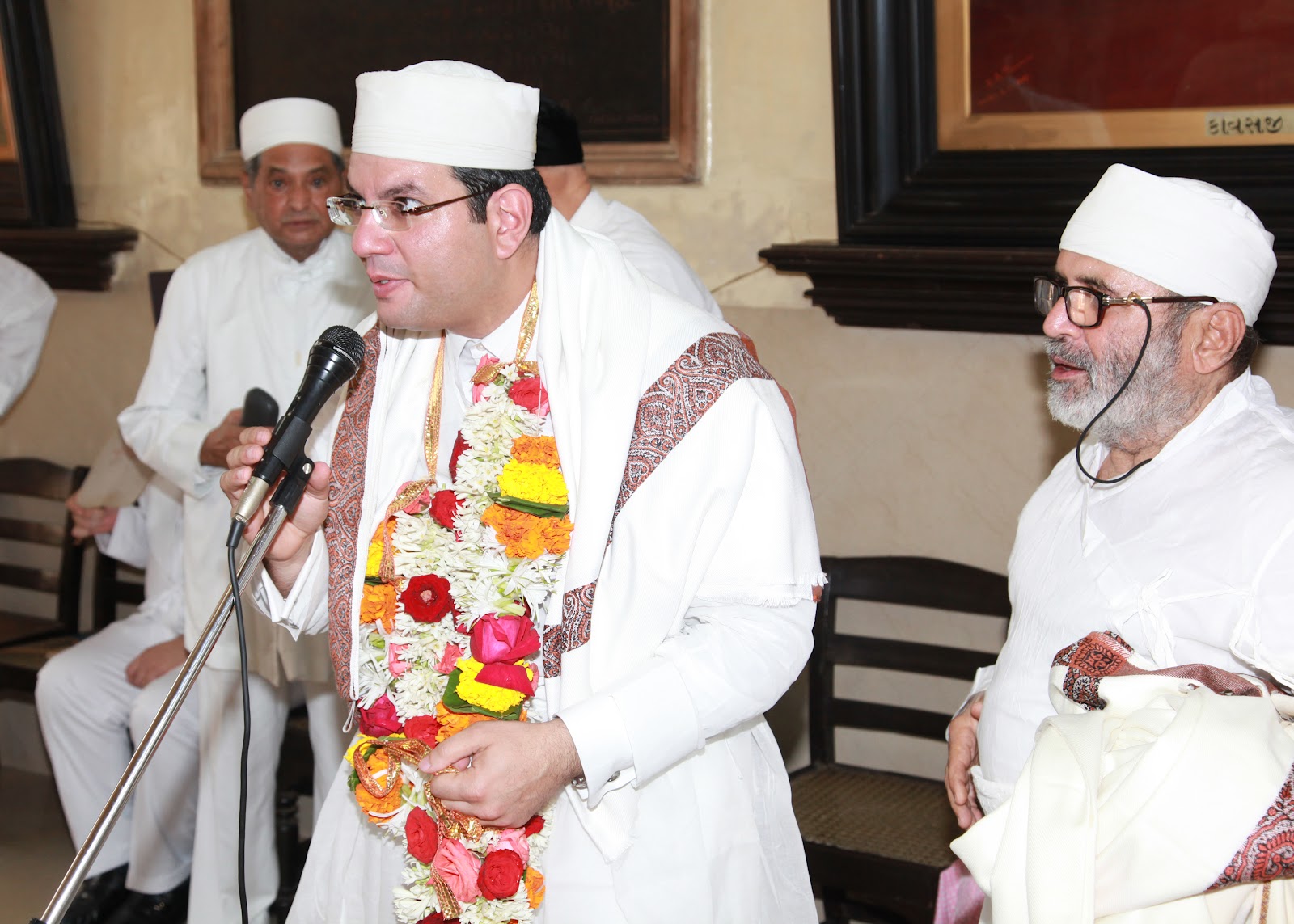
 At Mumbai's Anjuman Atash Behram, the new Nayab Dastur Dr. Jamasp was installed on Roj Ardibehesth Mah Ardibehesth, September 19, 2012, as trustee of the Atash Behram, Burjorji Antia looks on


Emergence of the new order
It is always exciting to witness the ascendance of the new order.
Few as we are, and fewer still as we appear to be getting, nothing gladdens the community more than the resurgence of the Parsi spirit with the arrival of fresh blood!
Kindly cast aside your cynicism, if you’re one of those jaded sorts who sighs and declares that GenNext is just not interested in religious adherence.
Week after week, we’re amazed at the response younger readers give us, particularly when it comes to articles pertaining to a further understanding of the faith. Believe it or not but young Parsis, for most of the part, are passionate about preserving both Parsipanu and the Zoroastrian religion.
Do read the story on the centre pages of aapru Jame this week, of how twenty-somethings across the world feel about being Parsi Zoroastrians and how infectious and admirable is their zeal!
And, yet, the road is not entirely easy for them, especially for those living in the West, where popular culture and peer pressure are often at odds with traditional religious practice.
That they still manage to hold on to our precious legacy and are proud of it, speaks volumes not just for the way in which they’ve been raised, but also for the power and glory of what has been given to us thousands of years ago by our Prophet.
It is a gift that cannot be taken for granted. And one that brings continuing joy for those who foster the faith!
Earlier this week, at Mumbai’s resplendent Anjuman Atash Behram, a beloved bastion of the devout, the 115th Salgreh festivities on September 19 turned into a double celebration with the induction of Nayab Dastur Dr. Jamasp, scion of the illustrious Jamasp Asa clan.
Succession planning is one of the most challenging and rewarding exercises that few enterprises or institutions can afford to ignore. Sadly, at the Wadiaji Atash Behram, a worthy successor wasn’t initiated upon the retirement of Vada Dasturji Dr. Firoze Kotwal
several years ago, although, reportedly, there’s no hereditary ‘gaadi’ of Dasturi there.
However, there is no reason why another scholar priest could not have been – or still cannot be – installed. If our biggest Atash Behrams don’t nurture the emergence of religious scholars of the stature of some of our current senior Vada Dasturjis, where is the young generation going to get guidance from?
The community and its Trusts must facilitate the emergence of a new cadre of Vada
Dasturji who will bring us credit with their scholarship, their understanding of contemporary issues and, above all, their unflinching resolve to conduct themselves with grace, without ever compromising on the core principles of the religion that have stood the test of time and made us who we are.
This reminds us of Tennyson’s sagacious assertion that “the old order changeth yielding place to new, and God fulfills Himself in many ways…”